
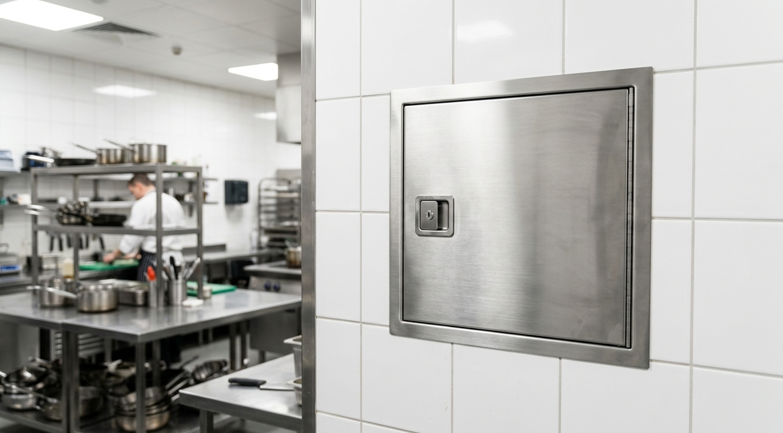
Stainless steel access panels are required in any location where moisture, chemical exposure, or sanitation protocols would corrode or contaminate a standard painted steel or galvanized panel. Commercial kitchens, public washrooms, food processing plants, and chemical washdown areas are the four primary environments that demand stainless steel construction, typically in 304 or 316 grade.
Why Standard Steel Panels Fail in Wet Environments?
A 16-gauge cold-rolled steel panel with a prime coat holds up fine behind drywall in a dry office corridor. Install that same panel in a restaurant kitchen above a dishwasher, and you will see rust bleeding through the paint within 18 months. The panel becomes a health code citation waiting to happen.
The failure mechanism is simple. Steam, grease-laden air, and caustic cleaning chemicals attack the paint film. Once moisture reaches bare steel through a scratch, cut edge, or fastener hole, corrosion starts and does not stop. Galvanized panels last longer, but galvanizing eventually fails under repeated chemical exposure. Only stainless steel resists the sustained assault of commercial wet environments.
Grade 304 vs Grade 316: Which Stainless and Where
Grade 304 Stainless Steel
It is (also called 18/8 for its 18% chromium and 8% nickel content) is the workhorse stainless steel for architectural products. It resists corrosion from water, mild cleaning chemicals, and food acids. Most access panel manufacturers offer 304 as their standard stainless option.
304 is the right choice for:
- Commercial kitchens (prep areas, cooking lines, dishwasher alcoves)
- Public restrooms and locker rooms
- Hospital patient rooms and corridors
- Brewery and winery production floors
- Indoor swimming pool mechanical rooms
Grade 316 Stainless Steel
Grade 316 adds 2% to 3% molybdenum to the alloy, giving it substantially better resistance to chlorides and aggressive chemicals. This grade costs roughly 20% to 30% more than 304.
316 is required for:
- Coastal buildings where salt air reaches interior mechanical spaces
- Chemical processing plants
- Pharmaceutical clean rooms with CIP (clean-in-place) protocols
- Industrial washdown areas using chlorinated sanitizers
- Wastewater treatment facilities
Quick Decision Table
| Environment | Cleaning Agents Used | Salt/Chloride Exposure | Recommended Grade |
| Restaurant kitchen | Degreasers, mild sanitizers | None | 304 |
| Hospital washroom | Quaternary ammonium, peroxide | None | 304 |
| Meat processing plant | Chlorinated cleaners, steam | Low | 316 |
| Coastal hotel kitchen | Standard degreasers | High (salt air) | 316 |
| Chemical plant | Acids, caustics | Variable | 316 (confirm with chemical compatibility chart) |
| Indoor pool mechanical | Chloramine off-gas | High | 316 |
Finish Options and Their Practical Implications
#4 Brushed (Satin) Finish
The industry standard for architectural stainless panels. Directional brush lines hide fingerprints and minor scratches. This is the finish you see on 90% of washroom accessories and commercial kitchen panels. It cleans easily with a damp cloth and mild detergent.
#2B Mill Finish
A cold-rolled finish that is smoother and more reflective than #4 but shows every fingerprint and water spot. Rarely specified for visible applications. It works for panels hidden behind equipment or above ceilings where appearance does not matter, but corrosion resistance does.
Electropolished Finish
Electropolishing removes a thin layer of surface material through an electrochemical process, creating an ultra-smooth surface that resists bacterial adhesion. Pharmaceutical and food processing specifications increasingly require electropolished stainless panels in critical areas. The process adds $40 to $80 per panel in finishing costs.
Powder Coat Over Stainless
Some projects specify stainless steel panels powder-coated to match adjacent wall colors. This provides the corrosion resistance of stainless underneath with the aesthetic flexibility of painted finishes. Be aware: if the powder coat is damaged, the exposed stainless may not color-match the surrounding wall. This approach works best in concealed or service-area applications.
Commercial Kitchen Requirements
Health Code Triggers
Most local health departments reference the FDA Food Code, which requires that “surfaces exposed to splash, spillage, or other food soiling” be constructed of smooth, durable, and corrosion-resistant materials. Access panels in the following kitchen zones typically trigger stainless steel requirements:
- Above cooking equipment: Panels within 36 inches of any cooking appliance, measured horizontally and vertically
- Behind dishwashing stations: Panels in the splash zone of commercial dishwashers
- In food storage and prep areas: Any panel that could be contacted during food handling
- Walk-in cooler and freezer walls: Panels accessing refrigeration lines or drain valves
A painted steel panel installed behind a fryer will eventually fail a health inspection, even if it passes on day one. Inspectors know what corrosion looks like, and they look for it behind equipment.
Grease Duct Access Panels
Grease duct cleanout panels are a separate category from wall access panels, but they share the same material requirement. NFPA 96 requires grease duct access panels to be constructed of the same material as the duct itself, typically 16-gauge or 18-gauge stainless steel. These panels must be grease-tight and listed for the application.
Washroom and Locker Room Applications
Why Galvanized Fails in Washrooms
Public restrooms generate sustained humidity levels between 60% and 80% during peak use. Add chemical cleaning agents (bleach, quaternary ammonium compounds, acid-based bowl cleaners) and you have an environment that strips galvanized coatings within 3 to 5 years.
Stainless steel access panels in washrooms are typically flush-mounted in tile walls, providing access to:
- Plumbing shut-off valves behind fixtures
- Drain cleanout access
- Electrical junction boxes for hand dryers and automatic fixtures
- Water heater and mixing valve compartments
Tile-Compatible Frames
When mounting stainless panels in tiled walls, specify a panel with a tile-bead frame that allows the surrounding tile to butt directly against the frame edge. This eliminates the gap between tile and panel that traps moisture and mold. Most manufacturers offer stainless panels in drywall application and plaster application frame styles that accommodate various wall assemblies.
Industrial Washdown Environments
What Qualifies as a “Washdown Area”
A washdown area is any space designed to be cleaned by high-pressure water spray, typically at 150 to 1,200 PSI. These environments are common in:
- Meat and poultry processing plants
- Dairy and beverage bottling facilities
- Commercial bakeries
- Pharmaceutical compounding areas
- Veterinary surgical suites
Panel Construction Requirements for Washdown
Standard access panels, even stainless ones, may not survive repeated high-pressure washdown. Washdown-rated panels need:
- Welded seams (no riveted or mechanically fastened joints that trap bacteria)
- Continuous gasket around the full door perimeter
- Concealed hinges that do not create food trap pockets
- Flush or recessed fastener heads that allow water to sheet off the surface
- Sloped or radiused frame edges that prevent water pooling
Babcock-Davis offers a waterproof access door line specifically engineered for washdown applications, with EPDM gaskets and stainless steel construction.
Cleaning Chemical Compatibility
Not all stainless steels tolerate all cleaning chemicals equally. The following table shows common washdown chemicals and their compatibility:
| Cleaning Agent | Concentration | 304 SS Compatibility | 316 SS Compatibility |
| Sodium hypochlorite (bleach) | 200 ppm | Good | Excellent |
| Sodium hypochlorite (bleach) | 5,000 ppm | Fair (may pit over time) | Good |
| Peracetic acid | 80 ppm | Good | Excellent |
| Quaternary ammonium | Standard | Excellent | Excellent |
| Phosphoric acid | 10% | Good | Excellent |
| Hydrochloric acid | Any | Not Recommended | Fair (limited exposure only) |
If the facility uses chlorinated sanitizers at concentrations above 500 ppm, always specify 316 grade. The extra material cost is a fraction of the cost of replacing corroded panels in a USDA-inspected facility during an active production run.
Specifying Stainless Panels: Common Mistakes
Mistake 1: Specifying Stainless Door in a Carbon Steel Frame
Some budget-driven specifications call for a stainless steel door leaf in a painted carbon steel frame. This creates a galvanic corrosion cell where the two dissimilar metals contact each other. The carbon steel frame corrodes at an accelerated rate, and you get rust streaks running down the wall within two years. Always specify matching materials for door and frame.
Mistake 2: Ignoring the Fastener Material
Stainless panels fastened with carbon steel screws will develop rust halos around every fastener within months. Specify stainless steel fasteners (304 or 316, matching the panel grade) in the hardware paragraph.
Mistake 3: Field-Cutting Stainless Panels
Cutting stainless steel with a standard abrasive wheel contaminates the cut edge with carbon steel particles from the wheel. Those embedded particles rust. If field modification is necessary, use a stainless-rated cut-off wheel (aluminum oxide free) and passivate the cut edge with a citric acid wipe or nitric acid solution.
Passivation Standards and ASTM A967 Compliance
Specifying 304 or 316 stainless steel access panels is only the first step in ensuring long-term corrosion resistance. Manufacturing processes such as shearing, punching, welding, and grinding embed free iron particles onto the stainless steel surface. If left untreated, these microscopic iron particles oxidize when exposed to air and humidity, creating orange surface rust spots known as rouge.
Chemical Passivation Protocols
To eliminate surface contamination, specified panels should undergo chemical passivation per ASTM A967. Passivation involves treating the stainless steel with a citric acid or nitric acid solution that dissolves free iron while leaving the chromium untouched. The chromium then reacts with oxygen to form a continuous, passive chromium oxide layer.
Inspection and Maintenance in Hygienic Facilities
In food processing plants, pharmaceutical suites, and healthcare washrooms, facility teams should implement a routine surface inspection protocol:
- Visual Sweep: Inspect welds and frame corners monthly for red oxide deposits or discoloration.
- Neutral Cleaning: Clean surfaces with warm water and non-chloride detergents using microfiber cloths.
- Electropolish Touch-Up: In ultra-clean environments, electropolishing provides maximum passive layer density, reducing micro-crevices where bacteria (such as Listeria or Salmonella) can colonize.
Real-World Scenario: Brewery Taproom and Production Floor
A 15,000 sq ft craft brewery project required 42 access panels. The architect initially specified all-stainless across the entire building, including the taproom, office, and production floor. The contractor pushed back on cost.
After zone analysis:
- Production floor and washdown areas (22 panels): 316 stainless, flush-mounted with EPDM gaskets. These panels access glycol lines, drain cleanouts, and CIP supply valves. Total upcharge over galvanized: $3,740.
- Taproom and public restrooms (12 panels): 304 stainless, #4 brushed finish. Access to plumbing and electrical. Upcharge: $1,080.
- Office, storage, and mechanical spaces (8 panels): Standard galvanized steel with prime coat. No moisture or chemical exposure. Zero upcharge.
Total project savings from zone-specific specification vs. all-stainless: $2,860. The panels in the production zone are now six years old with no corrosion or health citations.
Frequently Asked Questions
Can I use aluminum access panels instead of stainless in wet areas?
Aluminum resists corrosion well but is too soft for high-traffic commercial applications. It dents easily, and certain alkaline cleaners (like oven degreasers) attack aluminum aggressively. Stainless steel remains the industry standard for commercial kitchen and washroom panels.
Do stainless steel panels need to be fire-rated?
Fire rating depends on the wall assembly, not the panel material. If the panel is installed in a fire-rated wall or ceiling, it must carry a matching fire rating regardless of material. Stainless steel versions of fire-rated access doors are available from major manufacturers.
How do I clean stainless steel access panels without damaging the finish?
Use a mild detergent or stainless steel cleaner applied with a soft cloth, wiping in the direction of the grain (for #4 finish). Avoid abrasive pads, steel wool, and chlorine-based cleaners at full strength. For stubborn grease, use a degreaser rated for stainless steel contact.
What is the lead time for stainless steel access panels vs. standard steel?
Standard painted steel panels typically ship in 3 to 5 business days. 304 stainless panels ship in 5 to 10 days. 316 stainless and electropolished panels are often made-to-order with 3 to 4 week lead times. Plan accordingly for fast-track projects. Contact BL Wilcox for current availability.