
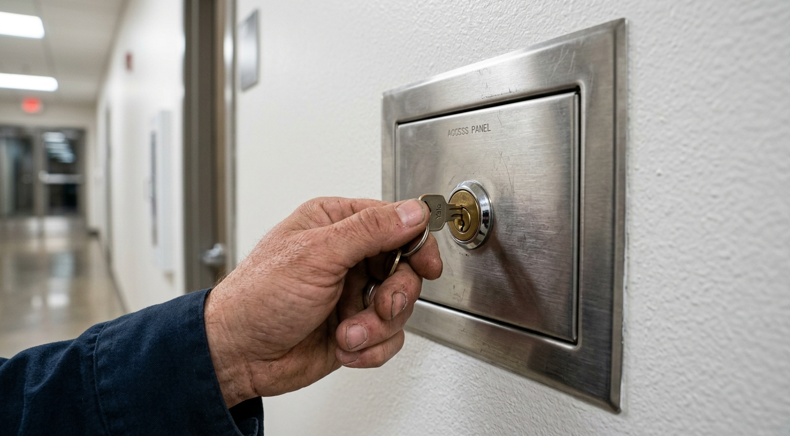
Lockable access panels use one of three hardware systems: a standard key-operated cam lock, a mortise cylinder lock, or tamper-resistant security fasteners that require proprietary driver bits. The right choice depends on who needs access, how often the panel opens, and the threat level of the space behind it.
Why Lock Hardware Matters More Than Panel Gauge?
Most spec writers spend hours on panel gauge, fire rating, and frame profile. Then they default to “keyed alike” in the hardware column and move on. That single line in Division 08 can cost a facility manager years of headaches.
A 16-gauge steel general purpose access door that anyone can open with a copied key is barely better than an unlatched panel in a school corridor. A tamper-resistant fastener on a data center chase wall, on the other hand, may force a technician to drive back to the shop for the proprietary bit during an emergency repair. Lock selection is an operational decision, not just a security checkbox.
Three distinct lock categories dominate the commercial access panel market. Each solves a different problem.
Standard Key-Operated Cam Locks
How They Work?
A cam lock is the simplest mechanism on the market. A flat metal tongue (the cam) rotates when you turn the key, pulling the door tight against the frame gasket. Quarter-turn models are most common. The key inserts, rotates 90 degrees, and the door releases.
Where Cam Locks Belong
Cam locks work best in spaces with moderate access frequency and low security threats:
- Mechanical rooms behind drywall ceilings
- Plumbing chase panels in hotel corridors
- HVAC filter access in office buildings
- Residential utility rooms
Common Keying Configurations
| Configuration | Description | Best Use Case |
| Keyed Alike (KA) | All panels open with the same key | Multi-unit apartments, hotel corridors |
| Keyed Different (KD) | Each panel has a unique key | Tenant spaces, private mechanical closets |
| Master Keyed (MK) | Individual keys per panel plus one master | Large commercial buildings, hospitals |
| Construction Core | Temporary core replaced after turnover | New construction, phased occupancy |
A common mistake: specifying keyed-alike cam locks across an entire building without checking whether the building already has a master key system. If the mechanical contractor installs KA locks during rough-in and the locksmith installs a different KA set during finish, you end up with two incompatible key families. Coordinate keying schedules with the owner’s locksmith before submitting panel hardware.
Limitations of Cam Locks
Cam locks offer zero pick resistance. A standard cam lock can be raked open in under 10 seconds by someone with a $15 pick set. They also wear quickly in high-traffic applications. After 5,000 to 8,000 cycles, the cam tongue develops enough play to rattle. That rattle becomes a noise complaint in occupied spaces.
For panels that need to stay shut reliably but do not face tampering threats, cam locks remain the most cost-effective option. Typical hardware upcharge over a screwdriver latch is $8 to $15 per panel.
Mortise Cylinder Locks
Anatomy of the Mortise Cylinder
A mortise cylinder threads into a housing machined into the panel door leaf. Unlike a surface-mounted cam lock, the cylinder sits flush with the panel face, leaving no protruding hardware. The lock body itself is typically 1-1/8 inch or 1-1/4 inch in length, with a standard 1-3/16 inch diameter.
Security Advantages Over Cam Locks
Mortise cylinders accept restricted keyway profiles. Brands like Best, Corbin Russwin, Schlage, and Medeco offer patented keyways that cannot be duplicated at a hardware store. This single feature makes mortise cylinders the standard for:
- Hospital medication rooms
- Server rooms and IDF closets
- Evidence storage in law enforcement facilities
- Financial institution back-of-house areas
- Any space requiring auditable key control
Interchangeable Core (IC) Options
Interchangeable core cylinders allow the building engineer to swap the lock core with a special control key, without removing the cylinder from the panel. This matters when a key is lost or when tenant turnover requires rekeying. Instead of calling a locksmith to disassemble the panel hardware, the engineer pulls the old core, drops in a new one, and the panel is rekeyed in 30 seconds.
Most security access doors from major manufacturers accept SFIC (Small Format Interchangeable Core) or LFIC (Large Format Interchangeable Core) cylinders. Confirm the panel manufacturer’s mortise prep dimensions before specifying the core format.
Cost Considerations
Mortise cylinder hardware adds $35 to $90 per panel over a standard cam lock, depending on the keyway brand and core type. The real cost, though, is coordination. Mortise cylinders require:
- Panel manufacturer to machine the correct mortise prep
- Hardware supplier to provide cylinders in the correct keyway
- Locksmith to pin and key all cores to the building master system
- Contractor to install panels with cores already loaded
Miss any of those steps and you get panels sitting in a corridor with empty cylinder holes for weeks while someone tracks down the right hardware.
Tamper-Resistant Security Fasteners
What Makes a Fastener “Security Grade”
Security fasteners replace the traditional screwdriver slot or Phillips head with proprietary drive patterns that resist removal with standard tools. The most common types in the access panel industry:
| Fastener Type | Drive Pattern | Security Level | Common Application |
| Torx Pin (T-15, T-20) | Six-point star with center pin | Low-Medium | Schools, public restrooms |
| Hex Pin | Hex socket with center pin | Medium | Detention facilities, transit stations |
| Snake Eye (Spanner) | Two-hole pattern | Medium | Washroom accessories panels, anti-vandal enclosures |
| Penta (five-lobe) | Five-point pattern | High | Corrections, psychiatric facilities |
| Proprietary (manufacturer-specific) | Custom pattern | Very High | Military, classified spaces |
When Security Fasteners Beat Cylinder Locks
Security fasteners solve a different problem than cylinder locks. Cylinder locks control who opens the panel. Security fasteners control how quickly someone can open it. In a behavioral health unit, the goal is not to prevent staff access. Staff need the panel open for maintenance. The goal is to prevent a patient from removing the panel in unsupervised minutes using improvised tools.
Fastener-secured panels are also preferred in:
- Public transit stations where panels face constant vandalism
- Outdoor utility enclosures exposed to theft
- Retail back-of-house areas with high employee turnover
- Any location where key distribution is impractical
Driver Bit Management
Every security fastener is only as secure as the driver bits. If the maintenance team leaves a penta driver in an unlocked tool bag, the fastener provides zero protection. Establish a driver bit custody protocol:
- Issue numbered bit sets to authorized personnel only
- Store bits in a locked tool cabinet, separate from general tools
- Log bit checkout and return
- Replace the fastener type if bits are lost or compromised
Combining Lock Types on a Single Project
Large projects often require multiple lock types across different zones. A hospital, for example, might use:
- Cam locks on ceiling access panels in public corridors (maintenance-only, low threat)
- Mortise cylinders on wall panels accessing medication rooms (restricted key, audit trail)
- Security fasteners on panels in the behavioral health unit (anti-ligature, tamper resistance)
The specification should address each zone with a separate hardware paragraph in Division 08 11 13 or 08 31 13. Do not lump all access panels into a single hardware callout. Specify the lock type, keying requirement, and finish for each zone independently.
For projects requiring fire-rated access doors, confirm that the lock hardware does not compromise the fire rating. UL 10B and UL 10C tested assemblies specify the exact latch and lock hardware included in the listing. Substituting an untested mortise cylinder for the listed cam lock voids the fire rating.
Key Control Protocols and Facility Rekeying Workflows
Facility engineers managing large institutional complexes must maintain accurate key schedules. When specifying lockable access panels, key control extends beyond initial installation. A lost key to a mechanical panel in a multi-story medical office building can compromise electrical distribution systems or domestic water shutoff valves.
Master Keying System Integration
When integrating access panel cylinders into an existing Great Master Key (GMK) hierarchy, coordinate directly with the factory hardware manager. Standard cylinder preps accept 6-pin or 7-pin Small Format Interchangeable Cores (SFIC). This allows the building locksmith to comb-pin cores to match existing sub-master control groups.
Lock Maintenance and Lubrication
Cam locks and cylinder cores in commercial access doors require annual maintenance to prevent latch sticking. Never use heavy petroleum-based lubricants or grease inside keyways, as they attract dust and debris that cause pin stack jamming. Use a dry graphite powder or a synthetic PTFE-based dry lubricant formulated for locks. Apply lubricant directly into the keyway and exercise the key five to ten times to ensure full pin distribution.
Real-World Scenario: University Science Building
A 120,000 sq ft university science building required 340 access panels across four floors. The original specification called for all panels keyed alike with standard cam locks. During design review, the facilities team identified three distinct security zones:
Zone 1 (Public Corridors and Lobbies): 180 panels. Standard cam locks, keyed alike on the university’s existing Schlage C keyway. Facilities staff carry this key on their standard ring.
Zone 2 (Research Labs with Controlled Substances): 95 panels accessing lab gas shutoffs and chemical ventilation controls. Medeco mortise cylinders on a restricted keyway, master-keyed to the Environmental Health and Safety director’s key. Only four keys issued.
Zone 3 (Animal Research Wing): 65 panels. Penta security fasteners with controlled driver bit distribution. IACUC compliance required documented access control. Bits stored in the facility manager’s locked office.
Total hardware premium over all-cam-lock specification: $14,200. The university’s risk management office approved the upcharge in a single meeting after the facilities team documented three incidents of unauthorized panel access in older buildings over the previous 18 months.
Frequently Asked Questions
Can I rekey a cam lock without replacing the whole lock?
Most cam locks are not rekeyable. The entire lock body must be replaced if a key is lost. Budget $12 to $25 per lock for replacement units. For buildings where rekeying is likely, specify mortise cylinders with interchangeable cores from the start.
Do security fasteners meet ADA requirements for access panels?
ADA does not regulate access panel hardware directly. However, panels in accessible routes must comply with protruding object limits under ADA Section 307. The lock type does not affect ADA compliance, but the panel projection and mounting height do. Ensure the panel face does not protrude more than 4 inches from the wall.
What lock type do detention facilities require?
Detention-grade access panels typically require either penta or proprietary security fasteners. Many jurisdictions follow the National Institute of Corrections guidelines, which prohibit standard key locks in inmate-accessible areas. Confirm requirements with the facility’s security consultant.
Are electronic locks available for access panels?
Some manufacturers now offer panels with card-reader or Bluetooth-enabled locks that integrate with building access control systems. These are typically custom orders with 6 to 10 week lead times. They make sense for data centers and pharmaceutical clean rooms where audit trails must be electronic.
Ready to Specify the Right Lock Hardware?
BL Wilcox carries a full range of lockable access panels from JL Industries, Karp, Milcor, and Babcock-Davis. Contact the BL Wilcox team for hardware selection assistance and keying coordination on your next project.