
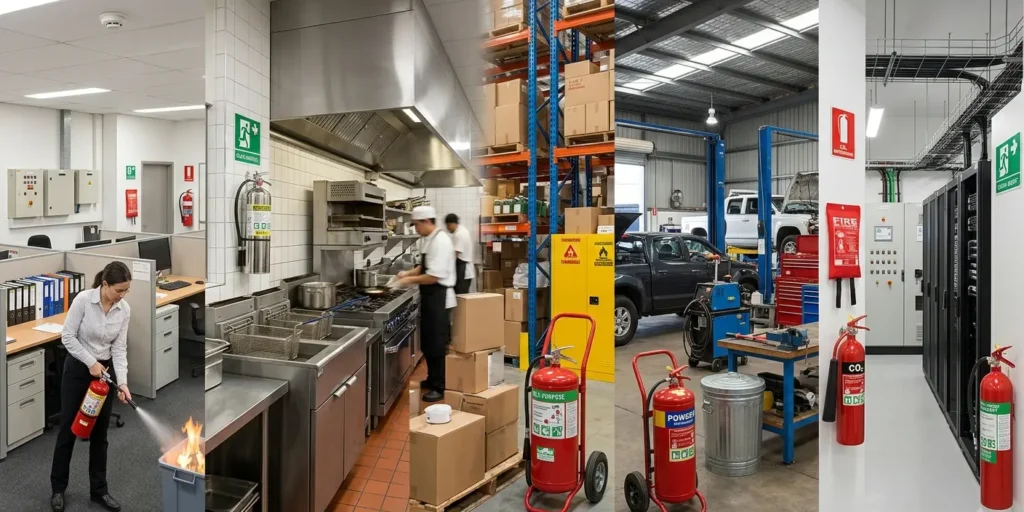
Every building holds a different mix of fire risks. An office with paper files and electrical panels faces different hazards than a commercial kitchen with grease and open flame, or a warehouse storing flammable liquids. Matching the correct fire extinguisher type to each of these environments is not a formality. It is one of the clearest ways a property owner protects tenants, employees, and the structure itself.
Why Fire Extinguisher Classification Matters
Fires are grouped into classes based on the fuel source. An extinguisher rated for one class of fire can be ineffective, or even dangerous, against another. Using water on a grease fire, for example, causes the fire to spread rather than go out. Using the wrong agent on an electrical fire can create a shock hazard for the person holding the unit.
Fire extinguisher classification exists so that building owners, facility managers, and fire marshals can match protection to actual risk. The National Fire Protection Association (NFPA) and Underwriters Laboratories (UL) establish fire extinguisher classification and rating standards. These standards guide fire safety requirements across the United States and influence most local fire codes. Following these standards during construction, renovation, or tenant improvements helps properties maintain compliance and protect occupants.
The Fire Extinguisher Classes
Class A: Ordinary Combustibles
Class A extinguishers are designed for fires involving wood, paper, cloth, rubber, and many plastics. These are the most common combustible materials found in offices, retail spaces, schools, and multifamily housing. Water and foam agents are typically used for Class A fires because they cool the fuel source and stop combustion.
Class B: Flammable Liquids and Gases
Class B fires involve flammable and combustible liquids such as gasoline, oil, grease, and solvents, along with flammable gases. These fires require an agent that smothers fuel and cuts off oxygen, making water unsuitable for extinguishing them. Dry chemical and carbon dioxide extinguishers are common choices for Class B hazards in garages, maintenance shops, and industrial spaces.
Class C: Electrical Equipment
Class C fires involve energized electrical equipment, including wiring, breaker panels, motors, and appliances. Because water conducts electricity, you must use a non-conductive agent. Carbon dioxide and dry chemical extinguishers rated for Class C fires protect server rooms, mechanical rooms, and areas with exposed electrical panels. These extinguishers use non-conductive agents to suppress fires safely around energized equipment without creating additional electrical hazards for occupants nearby. Once technicians de-energize the equipment, the fire classification may change depending on the surrounding materials involved in the incident. Fires involving ordinary combustibles or flammable liquids may then require extinguishers rated for Class A or Class B fires.
Class D: Combustible Metals
Class D fires involve combustible metals such as magnesium, titanium, sodium, and potassium. These fires burn at extremely high temperatures and react violently to water or standard extinguishing agents. Facilities that handle reactive metals require specialized dry powder extinguishers, which manufacturers design specifically for metal fires. Manufacturing facilities, machine shops, and laboratories commonly use these units.
Class K: Cooking Oils and Fats
Class K extinguishers are built specifically for commercial kitchens. Cooking oil and animal fat fires burn hotter than typical Class B liquids and can reignite if not properly saponified, which is why Class K wet chemical agents form a soapy layer that cools the fuel and prevents flashback. Restaurants, cafeterias, and any commercial kitchen with deep fryers or grills need Class K coverage in addition to standard kitchen suppression systems.
Extinguisher Agent Types and How They Work
Beyond classification, the agent inside the extinguisher determines how it performs and where it fits.
Water and foam extinguishers cool burning material and are rated for Class A fires. Foam variants can also handle certain Class B liquid fires by forming a barrier over the fuel surface.
Dry chemical extinguishers use a fine powder to interrupt the chemical reaction of combustion. Multipurpose ABC dry chemical units cover Classes A, B, and C, making them a common general-purpose choice for offices and mixed-use spaces. Regular dry chemical units are formulated for BC-only use.
Carbon dioxide (CO2) extinguishers displace oxygen around the fire without leaving a residue, which makes them a preferred option for electrical rooms, data centers, and areas with sensitive equipment. Because CO2 dissipates quickly and does not cool the fuel as effectively as other agents, it works best in enclosed spaces.
Wet chemical extinguishers are the standard for Class K kitchen fires, formulated to saponify hot oils and grease and prevent reignition.
Clean agent (halotron and similar) extinguishers leave no residue and are non-conductive, making them suitable for server rooms, museums, archives, and any space where dry chemical residue would damage equipment or sensitive materials.
How to Choose the Right Extinguisher for Your Building
Selecting fire extinguishers for a commercial property starts with a walkthrough of the space and its potential fire hazards.
Office and retail spaces generally need multipurpose ABC extinguishers placed at code-required intervals throughout the property.
For Class A hazards, units typically require placement within 75 feet of travel distance from one another.
Commercial kitchens need Class K extinguishers near cooking equipment, along with properly maintained kitchen suppression systems.
Mechanical, electrical, and server rooms benefit from CO2 or clean agent extinguishers that protect equipment without creating conductive hazards.
Warehouses, garages, and maintenance areas often require BC or ABC extinguishers with higher hazard ratings for increased risks.
These areas need higher-rated units, especially when they contain flammable liquids, fuels, or other hazardous materials.
Manufacturing facilities working with reactive metals need dedicated Class D extinguishers stationed near the specific process area.
A licensed fire protection consultant or your local fire marshal can help confirm the required extinguisher count, rating, and placement for a specific occupancy, since requirements vary by building size, occupancy type, and local amendments to the fire code.
Inspection, Maintenance, and Compliance
Buying the correct extinguisher is only the first step. NFPA 10 sets the maintenance schedule most jurisdictions enforce: a monthly visual inspection, an annual maintenance check performed by a certified technician, and periodic hydrostatic testing or internal maintenance depending on the extinguisher type and age. Dry chemical units typically need internal maintenance every six years and hydrostatic testing every twelve. CO2 units are tested by weight and typically need hydrostatic testing every five years.
Keeping documentation current matters as much as the physical inspection. Fire marshals commonly ask for inspection tags and service records during a walkthrough, and a lapsed inspection can result in a citation even if the extinguisher itself is functional.
Signage, Placement, and Accessibility
Fire code also governs how extinguishers are mounted, labeled, and accessed. Units must be mounted so the top is no higher than five feet from the floor for extinguishers weighing 40 pounds or less, and cabinets or brackets should keep the unit visible and unobstructed. Fire extinguisher cabinets protect the unit from damage and tampering while keeping it accessible in an emergency, and many building codes require clear signage identifying the extinguisher location, particularly when a cabinet or recessed mounting could otherwise obscure it.
For facilities managing a mix of hazards across a single property, fire hose cabinets and standpipe systems provide an additional layer of protection alongside portable extinguishers, particularly in multi-story buildings where fire department connections are part of the overall life safety plan.
Multipurpose Versus Specialty Units: Making the Call
Many building owners default to multipurpose ABC extinguishers everywhere on a property, and in most general occupancy spaces that is a reasonable baseline. But defaulting to one unit type across an entire building can leave gaps in areas with a distinct hazard profile. A server room protected only by a dry chemical ABC unit, for instance, technically meets Class C requirements, but the residue left behind after discharge can damage sensitive electronics beyond what the fire itself caused. In that scenario, a clean agent unit protects both the people in the room and the equipment they rely on.
The same logic applies to loading docks, where forklifts and other powered equipment introduce both electrical and flammable liquid risk in a single area, or to laboratory spaces handling reactive chemicals that may fall outside standard classification altogether. A room-by-room hazard assessment creates a more effective extinguisher layout than applying one standard across the entire property. Once you account for the required quantities, this approach often costs little more than a uniform layout.
Extinguisher Sizing and Rating Numbers
Beyond the letter classification, every extinguisher carries a numeric rating that indicates its firefighting capacity. On a Class A unit, this number represents the water equivalency of the extinguishing agent, so a higher number indicates a larger fire the unit can handle. On Class B units, the number represents the approximate square footage of flammable liquid fire the extinguisher can extinguish under test conditions. Understanding these numbers helps when comparing extinguisher options for a specific hazard level rather than assuming any unit labeled for a given class provides equal coverage.
Higher hazard occupancies, such as woodworking shops or facilities storing significant quantities of combustible material, often require higher-rated units or additional extinguisher placements beyond the minimum spacing requirement, since the rating number directly reflects how much fire the unit is capable of controlling before a professional response arrives.
Training Staff on Proper Use
Having the correct extinguisher on the wall only matters if the people nearby know how to use it. Basic fire extinguisher training, often built around the PASS method (pull the pin, aim at the base, squeeze the handle, sweep side to side), gives staff the confidence to respond to a small, contained fire in its earliest stage, when a portable extinguisher is most effective. Beyond the mechanics, training should also cover when not to fight a fire, since a fire that has grown beyond the incipient stage or is spreading faster than expected calls for evacuation rather than an attempt at suppression.
Many jurisdictions and insurance carriers expect documented fire extinguisher training as part of a broader emergency action plan, particularly in commercial and industrial occupancies with regular staff turnover. Building this training into new employee onboarding keeps the knowledge current across the workforce rather than concentrated among a handful of long-tenured staff.
Working with a Fire Protection Supplier
Because extinguisher requirements shift with occupancy type, square footage, and local code amendments, many building owners work with a supplier who can walk a property, identify hazard classes room by room, and recommend the right mix of units. B.L. Wilcox supplies a full range of commercial fire extinguishers, from water and foam units to dry chemical extinguishers, carbon dioxide extinguishers, and specialty Class D units for combustible metal hazards, along with mounting brackets, cabinets, and signage to keep a property both protected and compliant.
Frequently Asked Questions
What is the most common type of fire extinguisher for an office building?
Multipurpose ABC dry chemical extinguishers are the standard choice for most offices because they cover ordinary combustibles, flammable liquids, and electrical equipment in one unit.
Can one extinguisher cover multiple fire classes?
Yes. Multipurpose ABC extinguishers can put out Class A, B, and C fires, making them a common choice for mixed-occupancy buildings. Class D and Class K fires still require dedicated units.
How often should you inspect a fire extinguisher?
NFPA 10 requires building staff to perform a monthly visual check and a certified technician to complete a full annual inspection. Extinguishers also require hydrostatic testing at longer intervals based on their type.
Why can’t you use water extinguishers on a grease fire?
Water causes hot grease to splatter and spread the fire instead of extinguishing it. Class K wet chemical agents safely cool and saponify cooking oils to put out the fire.
How many extinguishers does a commercial building need?
The number depends on square footage, occupancy classification, and hazard level, with NFPA 10 setting maximum travel distances between units. A local fire marshal or fire protection supplier can calculate the exact requirement for a specific property.
Do CO2 extinguishers expire?
CO2 extinguishers do not have a fixed expiration date, but inspectors check their weight during inspections and perform hydrostatic testing every five years to ensure the cylinder remains safe to use.